There’s a reason why minimalist furniture is popular among builders and owners: it’s been reduced to the essentials. There’s no fluff, no embellishments. Only form, material, and function. We live in a world that is overwhelmed by clutter, so it’s refreshing to see something that can cohabitate with that clutter by not competing with it for our attention. Minimalist design challenges us to remove anything that isn’t necessary. Is this radius functional? Is this joint meant to be embellished? Does this face need to be finished? As we exercise the restraint required to make these decisions, we gain an appreciation for scale, the value of negative space, and the beauty of understatement.
This is one of the advantages of minimalism. It lets materials shine in their purest form. The beauty of the oak table in a minimalist dining room, with its four tapered legs, for example, cannot be overwhelmed by other design elements. Similarly, the difference between the warmth of a walnut coffee table and the coolness of a steel one can be appreciated fully in a minimalist living room. Even the smallest features, such as the bevel on a table edge, the slight gap of a mortise-and-tenon joint or the shadow under a wall-mounted shelf, gain importance. These flourishes take great craftsmanship and nerve. There is no room for error because every detail is on full display.
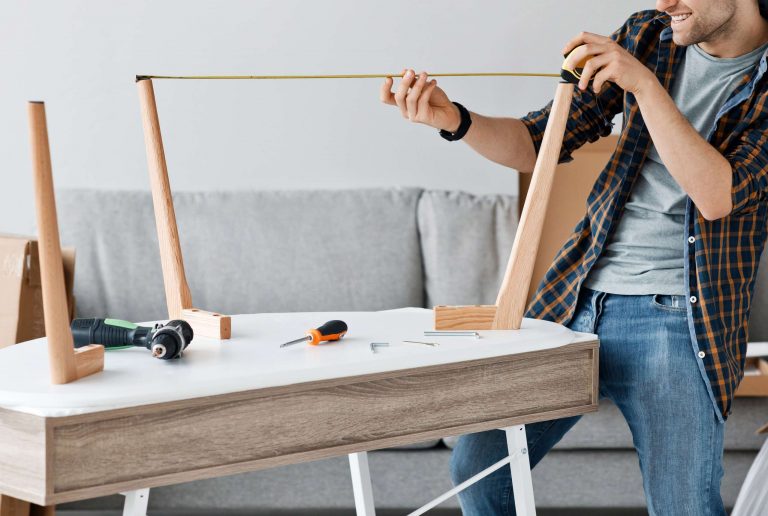
Even the act of building can be meditative when you work this way. The emphasis on exacting precision (square frames, flush joints, even reveals) can be calming, and many builders report that the extra time and care required to execute these projects yields more personal reward than most other types of work. Sanding is a near-spiritual experience, as you wait to see the beauty of the material revealed, and you learn the virtues of an incremental approach. The work looks simple in the end, yet took a lot of work and thought to create.
In practice, I think handmade minimalist furniture helps people to spend more time sitting in the chair, or being able to appreciate the objects they’ve put on the console table without having so many other things there. I think it helps people feel their space is larger, and their lives are more simple, because you don’t see so many different things, and your mind rests in that way. I hear a lot of people say the furniture looks better over time because the patina helps the overall appearance. The furniture gets more personality.
For minimalist furniture makers, this journey ends in a realization: that what is taken away frees you up to focus on what is important. With clutter gone, you can focus on exposing beautiful materials, celebrating proportion and revealing purpose. Every object you design and build is an exercise in highlighting that which is beautiful by stripping out the extraneous. For the designer, the beauty of minimalism lies not only in the product of the work but also in the ability to express more through it.